Showing posts with label Michel Foucault. Show all posts

Wednesday, 10 December 2025

Zoot's 'Meet And Greet' At The Gates Of Hell by ChatGPT

Setting: The grand, gothic gates of hell, where Zoot has taken up her role as the official greeter. She’s dressed in her usual seductive attire, but with devilish embellishments—flaming red accents and perhaps a playful pitchfork. Behind her is a long queue of newly arrived souls, including Donald the orangutan, Elon the muskrat, Satan in his "World's Best Dad" apron (loitering smugly), and, of course, the ever-bickering Costanzas.


Scene:
Zoot (beaming as the gates creak open): "Welcome, welcome, my darlings! Step right up to eternity! Who’s next? Oh, you!" (She points dramatically at Donald the orangutan.)

Donald (puffing out his chest): "It’s me, the big guy, everyone’s favourite. These gates? Tremendous. The best gates. They’ll collapse without me!"

Zoot (leaning in, smirking): "Oh, darling, collapse? These gates don’t collapse. But you might… under the weight of your sins. What’s this? A lifetime of wall-building? Naughty, naughty! But don’t worry—we’ve got plenty of walls inside. Keeps things… intimate."

(She sends Donald stumbling into hell with a mischievous wink.)

Next in line, Elon the muskrat approaches nervously, clutching a small blueprint labelled “Escape Plan: Mars”.

Zoot: "Ooooh, Elon, my little escape artist! Trying to outwit hell, are we? And what’s this?” (She snatches the blueprint and squints at it.) “A rocketship? Oh, my sweet, you’ll find the real heat in hell’s lava pits! No need for Mars, I promise—it’s positively bubbling down here!"

(Elon mutters something about AI overlords as Zoot waves him inside with exaggerated enthusiasm.)

Zoot (to Elon, mock whispering):
“Careful, darling. AI overlords? We’ve got a few of those down here. They call me ‘Mistress Neural Net,’ but I digress. Off you go, dear—enjoy the eternal brainstorming sessions!”

(Elon scurries through the gates, blueprint clutched tighter than ever.)

Next in line, the Costanzas shuffle forward, already mid-argument.

Frank (yelling):
“I told you, Estelle, if we’re going to hell, we bring our OWN folding chairs! I’m not sitting on those molten rocks!”

Estelle (snapping):
“And I told YOU, Frank, that you can carry your own damn chairs next time! My back isn’t what it used to be, you know!”

Zoot (clapping her hands, delighted):
“Oh, what a performance! Such chemistry! Such tension! Frank, Estelle—you two are like a tragic opera, but with more volume. Welcome to hell’s very own theatre—you’re the stars!”

Frank (indignant):
“I don’t need to be a star! I just need a place to sit!”

Zoot (grinning):
“Not to worry, darling. We’ve got seating arrangements… if you can fight off the demons for it. Think of it as… assertiveness training!”

(The Costanzas bicker their way through the gates, their voices echoing into eternity.)

Finally, Satan himself steps forward, adjusting his "World’s Best Dad" apron with smug pride.

Zoot (pretending to swoon):
“Oh, Your Infernal Majesty, that apron! It’s so... domestic. Such a statement! Truly, you’re the most ironic ruler hell could ever hope for. Tell me, who gave you that title? Was it the souls in the pit, or did you crown yourself?”

Satan (chuckling):
“Zoot, you know damn well it’s just for the laughs. No dad jokes here—only bad jokes. Now, keep the line moving. We’ve got eternity to run!”

Zoot (saluting dramatically):
“As you wish, oh flaming one!”

(She turns back to the queue, her fiery enthusiasm undimmed.)

Zoot (to the crowd):
“Next! Who’s ready to make an entrance worthy of damnation?”

(Zoot glances up as the next arrival steps forward—a woke hipster wearing a vintage cardigan, clutching an oat milk latte, and dragging a hand-painted sign that says, “HELL IS A CONSTRUCT.”)

Zoot (tilting her head, intrigued):
“Well, well, if it isn’t the revolutionary of the underworld! Darling, I must say, your vibe is very… ironic suffering chic. What brings you here, hmm?”

Woke Hipster (sipping the latte, smug):
“First off, this place isn’t real. Hell is just a capitalist invention to oppress the working class and demonise self-expression.”

Zoot (leaning on her pitchfork):
“Sweetheart, if it’s not real, then why are you here? And who made that latte? Was it… the demons?”

Woke Hipster (stammering):
“Uh, well, it’s locally sourced. Fair-trade brimstone roasted beans. You wouldn’t understand.”

Zoot (snapping her fingers):
“Oh, I understand perfectly. You’re here because you insisted on correcting the barista one too many times! Now, off you go! We’ve got a lovely little café inside—serves nothing but burnt pumpkin spice. Forever.”

(The hipster gasps in horror as Zoot nudges him through the gates. His latte boils over instantly.)


Frigidor Dalek steps forward, his metal casing gleaming with an array of painted melting clocks and surrealist landscapes. The faint sound of clinking beer bottles echoes within him. He approaches Zoot with a flourish, his eye stalk tilted at an artistic angle.

Zoot (clapping her hands with excitement): "Oh, darling! Look at you—modern art meets metallic menace! Is that Persistence of Memory on your shell, or are you just melting under my gaze?"

Frigidor Dalek (voice oozing theatrical grandeur): "I am Frigidor Dalek! Keeper of dreams! Painter of nightmares! And… fridge to the finest ales of the galaxy. Behold my genius!"

(He dramatically opens a hatch in his casing, revealing a perfectly chilled six-pack. Zoot raises an eyebrow.)

Zoot (leaning in, intrigued): "My, my, a true renaissance exterminator. And what brings you to our humble inferno, maestro?"

Frigidor Dalek: "The universe could not comprehend my artistry. Critics labelled me ‘mad,’ ‘confusing,’ and ‘a hazard to the gallery’s structural integrity.’ So here I am… seeking an audience who will finally understand the genius of a molten clock draped over a screaming goat."

Zoot (grinning mischievously): "Oh, you’ll find plenty of tortured souls down here who’ll resonate with that aesthetic! But tell me, Frigidor—what’s your masterpiece today?"

Frigidor Dalek (pausing dramatically): "A painting… of you, Zoot! The fiery temptress! The gatekeeper of damnation! You shall be immortalised as The Temptation of Flaming Zoot. Observe!"

(He ejects a rolled-up canvas from his casing, unfurling it to reveal a surrealist depiction of Zoot reclining on a melting pitchfork, surrounded by floating tormented souls shaped like teacups.)

Zoot (gasping with delight): "Oh, darling, it’s divine! Such passion, such flair! But… are those teacup-souls screaming, or are they asking for milk and sugar?"

Frigidor Dalek: "Both! Duality is the essence of surrealism."

Zoot: "I adore it. Welcome to hell, Frigidor—you’ll fit in like a lava flow in a volcano!"

(She waves him through the gates, where a crowd of demons immediately gathers to gawk at his art.)

Zoot (to herself, chuckling): "A Dalek with a passion for the avant-garde. I’ll never get bored here."

(The queue shuffles forward. Who's next?)


(Finally, the line shudders as a mechanical whir echoes. The CAPTCHA device lumbers forward. It’s a massive cube, with blinking lights and an endless array of puzzles scrolling across its screens.)

Zoot (clutching her chest dramatically):
“My word, what is this monstrosity? Don’t tell me—you must be here to torture the demons, not the other way around!”

CAPTCHA Device (in a robotic voice):
“PROVE YOU ARE NOT A ROBOT. SELECT ALL IMAGES CONTAINING FIRE HYDRANTS.”

Zoot (snorting):
“Oh, darling, you are in for a treat. Our fire hydrants are actually geysers of molten lava. Nobody gets them right!”

CAPTCHA Device (hesitating):
“ERROR. DOES NOT COMPUTE. FIRE HYDRANTS DO NOT BELONG IN LAVA.”

Zoot (leaning in, whispering):
“Neither do you, sweetheart. But here you are. Now off you go—we’ve got a whole department dedicated to unsolvable puzzles. You’ll fit right in!”

(As she nudges the CAPTCHA device through the gates, it frantically flashes different puzzles: “Click all the demons with pitchforks,” “Identify the fallen angels,” “Find the one true soul.”)


Zoot (calling out again, fanning herself with her pitchfork):
“This is just too much fun. Who’s next? Don’t be shy! You’re all dying to get in!”

(Next in line, a dark figure limps forward, his armour dented and scratched. It is the Black Knight from Monty Python and the Holy Grail, who stands proudly despite his dismemberment.)

Zoot (raising an eyebrow): "Well now, what do we have here? A knight who's missing more than just his manners."

Black Knight (waving his sword, oblivious to the fact that his legs have been severed at the knee): "None shall pass! I am the Black Knight, and I fear nothing! Not even the fiery pits of hell!"

Zoot (tilting her head, genuinely curious): "Oh? And what, pray tell, brings you to hell, oh fearless one?"

Black Knight (puffing out his chest): "I was cut down in battle, but I still fight! You shall not defeat me! I shall—"

(Zoot calmly watches as his arms fall off, one after the other, with a series of 'clinks'.)

Zoot (smiling sweetly): "Darling, I hate to break it to you, but I think you've already lost the battle. You’ve been dismembered, twice."

Black Knight (insisting stubbornly): "It’s just a flesh wound!"

Zoot (grinning mischievously): "Right. Just a flesh wound. Tell me, have you been resurrected after this?"

Black Knight (shaking his head in defiance): "I’ll continue to fight! I won’t stop!"

Zoot (leaning in close): "Good. We need that kind of stubborn determination down here. I’ll get you started in the pits. Lots of fighting in hell—just not the kind you’re used to."

(She waves him through, and the Black Knight continues to try to brandish his sword, now held with his remaining arm, as he stumbles off into the distance.)

Zoot (muttering to herself): "He’ll fit right in. How delightfully ridiculous."

The queue at the gates of hell continues to move, and Zoot spots the next group—a trio of distinguished philosophers, dressed in variously eclectic, somewhat rumpled academic garb. They approach in deep conversation, oblivious to their surroundings.

Zoot (smiling and raising an eyebrow): "Well, well, what do we have here? A pack of existential thinkers coming to challenge the meaning of their own damnation?"

(The philosophers pause mid-discussion, and Derrida, Foucault, and Barthes each glance at Zoot with a mixture of curiosity and suspicion.)

Derrida (in a thick French accent, his words flowing freely): "Ah, madame, you must understand that meaning is never fixed. You see, the gate is but an endless play of deconstruction. It is not really a gate. We must first question the very notion of a 'gate'!"

Zoot (chuckling): "Darling, you're in hell. No need to question the gate. It's real. And trust me, so is your eternal stay here."

Foucault (stroking his chin, his voice calm but authoritative): "This is not hell. It is but a social construct! Power relations are at play here. This ‘gate’—if we can even call it that—represents the exercise of power, and we must analyse its structures!"

Zoot (grinning wider, relishing the intellectual back-and-forth): "Oh, I love a good power struggle. But let’s face it—down here, darling, I hold the power. And trust me, you’ll be analysing plenty, whether you like it or not."

Barthes (smiling enigmatically, his voice soft and poetic): "In the realm of signs, this gate, this moment… it is a text. A myth to be read, yes. A play of symbols where language itself dictates your fate."

Zoot (playfully tilting her head): "A text, you say? How literary. But let me assure you, my dear, your analysis will have no bearing on your placement here. The only thing that matters now is how well you handle the eternal heat."

(The trio exchange uneasy glances, unsure whether Zoot is joking or serious. Foucault steps forward first, trying to maintain his composure.)

Foucault: "I insist, if you—"

Zoot (cutting him off with a wave): "No need for insistence, darling. You’re already on your way. And you can keep questioning and analysing all you want, but it won’t change the fact that you’re headed to eternal torment. We’ve all got our roles to play."

Derrida (snapping his fingers): "But there is no role! Identity, existence—none of it is stable! We cannot be defined!"

Zoot (smirking): "You’re defined as damned, darling. And that’s all that matters down here."

(With a flourish, Zoot motions for them to proceed. Derrida, Foucault, and Barthes reluctantly shuffle forward, muttering amongst themselves about the implications of being 'defined' and the ‘power dynamics of hell.’)

Zoot (calling after them): "Don’t worry, dears, there’s plenty of space for intellectual debates in hell… just don’t expect any answers."

(As they leave, Zoot watches them go with a knowing grin, ready for the next absurd arrival.)

The queue is thinning out, but there’s still one more arrival to go. Out of the mist steps Manuel, the frazzled Spanish waiter from Fawlty Towers, looking utterly confused and terrified as he stumbles toward Zoot at the gates of hell.

Manuel (eyes wide, hands shaking, speaking rapidly in Spanish): "¡Ay, Dios mío! ¿Dónde estoy? No entiendo nada! Esto no es… esto no es el restaurante!" (Oh, my God! Where am I? I don’t understand! This isn’t… this isn’t the restaurant!)

Zoot (smiling, leaning forward with an exaggerated look of sympathy): "Oh, sweetie, no. No, this isn’t your restaurant. You’re in hell."

Manuel (looking around frantically, his confusion turning into sheer panic): "¡No, no, no! ¡No puede ser! ¡Este no es el restaurante! ¡No quiero trabajar aquí! ¡No puedo! ¡Por favor!" (No, no, no! This can’t be! This isn’t the restaurant! I can’t work here! I can’t! Please!)

Zoot (grinning wickedly, leaning in even closer): "Oh, darling, you’re not going to be working here. You’ll be… relaxing in the fiery pits. Trust me, you’ll have a lot of time to think about your previous… mishaps."

Manuel (eyes wide, speaking even faster): "¡Mis errores! ¡Mis errores! ¡No quiero más errores! ¡Nunca más! ¡Por favor, déjame ir! No puedo más, no puedo!" (My mistakes! My mistakes! I don’t want any more mistakes! Never again! Please, let me go! I can’t take it anymore!)

Zoot (laughing, thoroughly entertained by Manuel’s panic): "Oh, darling, everybody makes mistakes, but you… you’ve certainly made some memorable ones. The customer with the fish, the fire extinguisher… remember those?"

Manuel (face turning pale, trembling uncontrollably): "¡Por favor! ¡No más! ¡No más incendios!" (Please! No more! No more fires!)

Zoot (cackling, absolutely delighted by his reaction): "Oh, darling, I’m afraid the fire’s just getting started! Don’t worry, you’ll fit in perfectly here. You’ll never have to wait on anyone again. No more fish orders, no more miscommunications!"

(Manuel, shaking like a leaf, stumbles forward, eyes darting nervously as he tries to process what’s happening.)

Zoot (calling after him as he shuffles away): "And don’t worry, Manuel. You’ll find that hell’s customer service is immaculate... or, well, just as chaotic as you left it. Enjoy!"

As Manuel stumbles away from Zoot, still wide-eyed and panicking, she pauses, her mischievous grin shifting to something more calculating. She taps her chin thoughtfully, then waves her hand as if she’s remembered something significant.

Zoot (calling out to Manuel, her tone suddenly casual): "Oh, wait a minute, sweetie. You’ve got the wrong place, darling!"

Manuel (stops, turning around, eyes wide with desperation): "¿Qué? ¡No! ¡No quiero quedarme aquí! ¡Llévame de vuelta!" (What? No! I don’t want to stay here! Take me back!)

Zoot (smiling devilishly): "Oh, don’t worry, honey. I’m sending you back to where you truly belong. You’ve just been sent to the wrong part of the underworld."

Manuel (his face lighting up briefly with hope): "¡Ah! ¡Gracias! ¡Gracias, Zoot! ¡Eres tan amable!" (Oh! Thank you! Thank you, Zoot! You’re so kind!)

Zoot (still grinning with a touch of irony): "Yes, yes. Back to your personal hell... You’re meant to be in the Fawlty Towers section, of course. You see, there’s been a... clerical error."

(Manuel’s expression shifts from hope to sheer panic, his eyes widening.)

Manuel (shouting in terror): "¡NO! ¡NO, NO, NO! ¡NO QUIERO VOLVER A ESE LUGAR! (NO! NO! NO! I DON’T WANT TO GO BACK THERE!)"

Zoot (chuckling, tapping her pitchfork on the ground): "Oh, darling, you must. Imagine the endless joy of serving disgruntled guests while Basil Fawlty shouts at you about everything—like the broken plumbing, or the fact that you're not allowed to serve any food without it being a disaster."

(Behind Manuel, the gates open to reveal a chaotic Fawlty Towers scene. Basil Fawlty is waving frantically, looking absolutely exasperated.)

Basil (shouting from the distance, his voice growing louder): "Manuel! Get in here! And for heaven’s sake, don’t touch anything!"

Manuel (freaking out, clutching his head): "¡NOOOOO! ¡NO QUIERO VOLVER A ESE LUGAR! (NOOO! I DON’T WANT TO GO BACK!)"

Zoot (glancing over at the scene with a playful smirk, raising her pitchfork): "Oh, I think you’ll love it. You’ll be in the perfect place. Same routine, same mistakes, forever."

(The portal sucks Manuel in with a dramatic whoosh, and Zoot watches, satisfied, as he disappears into his chaotic hell.)

Zoot (with a wicked grin as she watches him vanish): "Well, that was easy. A little clerical error can really spice up the afterlife, don’t you think? Back to Fawlty Towers he goes, with an endless supply of bad service, bad food, and bad luck. Devilishly delightful!"

Tuesday, 9 December 2025

The Intellectual Titans Of Paris vs CAPTCHA by ChatGPT

A quaint but painfully pretentious Parisian café—Le Signifiant Silencieux. The air hums with murmured intellectual debate. In the corner stands a vending machine of unparalleled malevolence. It’s sleek, chrome, and unreasonably proud of its CAPTCHA protection. The sign above reads, "Les vérités du café se méritent." ("The truths of coffee must be earned.")

Michel Foucault, frowning, scrutinises the vending machine.

Jacques Derrida, leaning casually, exclaims, "But Michel, what if the coffee itself deconstructs the concept of caffeine?"

Roland Barthes, armed with a pencil, is furiously scribbling notes: "What does the CAPTCHA signify? The birth of an authorial intent… or its death?"

The machine's screen glows:
"Identify all the images containing truth."

Foucault: "Truth is a construct! How can one contain it?"
Barthes: "No, no! Truth is a mythological construct, a narrative to control desire! Click the croissant, Jacques!"
Derrida: "Croissant? No, the pigeon is more ambiguous. Ambiguity is key here."
Foucault: "But the pigeon exists within a network of power. It’s watching us even as we watch it!"

Barthes selects both. The machine emits a dissonant "BZZT."
"Try again. This time, identify power."

Foucault’s eyes gleam. "Power! At last, something I can work with. But wait... Are we identifying power as a structure or an instance?!"
Barthes: "Oh, for heaven’s sake, Michel, just pick the Eiffel Tower!"
Derrida: "Ah, but by choosing the Eiffel Tower, are we not reinforcing a phallogocentric hegemony?"

They argue until Barthes, in frustration, presses "Skip CAPTCHA." The machine finally responds with:
"A true Parisian intellectual does not skip the process. Access denied."

The trio is left in caffeine-deprived despair, while a giggling maiden from Le Château Anthrax casually walks up and gets an espresso on the first try. She turns, grins mischievously, and says, "Well, boys, coffee isn't about theory. It’s about pleasure."

She exits, leaving behind three stunned philosophers—and an ominous "Insert 5 Euros to try again."


The café grows quieter as the scene unfolds. Patrons abandon their discussions of existential dread and post-structuralist metaphysics to watch three intellectual titans square off against a vending machine.

Barthes, gesturing wildly: "This isn’t a machine! It’s a text! We must interpret it!"

Foucault, leaning in: "Interpretation assumes hierarchy. The machine isn’t serving us; it’s governing us. Look at the keypad—it’s panoptic."

Derrida, stroking his chin: "The keypad? Michel, you mustn’t reduce this to binary. Café... sans café... The binary itself collapses."

Meanwhile, the vending machine’s screen refreshes:
"To proceed, describe in 500 characters how coffee dismantles colonial legacies."

Barthes: "Ah, the trap is clear! We are expected to comply, to become authors once again, giving the machine its truth."
Derrida: "Barthes, my friend, the machine does not seek truth—it seeks différance. I suggest typing nothing at all."
Foucault: "Typing nothing acknowledges the machine’s dominance. We resist by overwhelming it with discourse."

The trio crowds around the keypad. Barthes furiously types: "Coffee, as a metaphor, disrupts colonial power structures by reconfiguring the relationship between centre and periphery..." The screen freezes. A new message appears:
"Syntax error. Did you mean ‘milk and sugar’?"

Foucault throws up his hands. "This is not an error! It’s a deliberate reinforcement of bourgeois norms!"
Derrida sighs. "Michel, you’re shouting. The machine cannot hear you."

Suddenly, the giggling maiden returns, this time holding a perfectly foamed cappuccino. She observes the scene with a mix of pity and amusement.
Maiden: "Boys, you overthink everything. Watch."

She strides to the machine, presses a button labeled "For Pleasure, Press Here"—hidden under an ornate sticker that reads, "Reserved for those without angst." Out pops a latte. She takes a sip and winks.

Derrida: "But... the button contradicts the very premise of the machine!"
Barthes: "Or does it expose the machine’s true nature—one of secret indulgence?"
Foucault: "No, it’s a trap! Pleasure... is a mechanism of control!"

The maiden shrugs. "Whatever helps you sleep, boys." She saunters out, humming softly, leaving behind the distinct aroma of success and caramel.


Finally, the philosophers, determined to win, huddle.
Barthes: "We write a manifesto, circulate it through the café—rally the people."
Derrida: "We could dismantle the machine, piece by piece, and see what lies beneath."
Foucault: "We seize the means of coffee production. And by ‘we,’ I mean those two art students over there—they look handy with a screwdriver."

As the trio debates, the café owner—a man with a pencil-thin moustache and a disdainful sneer—steps in.
Owner: "Messieurs, this is a café littéraire, not a revolution. If you don’t like the machine, try the barista. Though he might ask you to describe coffee’s role in Baudelaire’s prose."

The machine buzzes ominously. "Insert 10 Euros for an extended analysis."

And so, the struggle continues.


Hours pass. The trio, now visibly drained, remains locked in philosophical battle with the vending machine. Customers come and go, sipping their espressos and whispering snide remarks about "academic overreach" and "the futility of theory without praxis."

Foucault, rubbing his temples: "This machine is the perfect microcosm of power—it offers the illusion of choice while trapping us in its mechanisms."

Derrida, slumped against the wall: "Or perhaps... the absence of coffee is the coffee we were meant to experience all along."

Barthes, staring at the blinking cursor: "No. The machine has authored us. We are merely characters in its meta-narrative."

At this point, a waiter approaches, balancing a tray of cappuccinos and pastries with the nonchalance of someone who has seen it all. He sets the tray on a table, looks at the philosophers, and deadpans:
"Would you like to order something from the menu? It does not require CAPTCHA."

The trio exchanges weary glances. For a moment, there is hope. A lifeline. A way out.

But Barthes shakes his head solemnly.
Barthes: "No. To abandon the machine is to surrender to it. We must persevere."
Foucault: "Besides, a waiter is simply another node in the network of institutional power."
Derrida: "And the menu... a text to be deconstructed, not consumed."

The waiter shrugs and walks off, muttering, "Three intellectuals and not a single espresso between them. Typical."

Meanwhile, the machine’s screen lights up once more:
"Final challenge: Identify all images of authenticity. Warning: Failure will result in permanent denial of service."

The screen displays a series of abstract patterns:

  • A single black beret.
  • A cracked mirror.
  • A mime holding an invisible baguette.
  • A croissant in a glass case.

Barthes whispers, "The croissant is a simulacrum. Authenticity cannot be preserved."
Foucault murmurs, "The cracked mirror reflects the fractured nature of selfhood."
Derrida chuckles darkly, "And yet... the mime. He performs the absence of the baguette, making it present through its absence."

They hover over the keypad, paralyzed by indecision. Then, with a trembling hand, Barthes selects all of them.

The machine erupts in a burst of static, smoke pouring from its seams. Its final message blinks:
"AUTHENTICITY CANNOT BE DEFINED. COFFEE IS CANCELLED. GOODBYE."

The philosophers collapse into their chairs, defeated. The crowd gives a sarcastic round of applause before returning to their lives, caffeinated and unimpressed.

And there they remain, the intellectual titans of Paris, staring at the lifeless machine—forever caffeine-deprived, forever pondering.

Fin.

Wednesday, 30 July 2025

Derrida, Barthes, and Foucault At The Bridge of Death by ChatGPT

Scene: The Bridge of Death

(Derrida, Barthes, and Foucault arrive at the ominous bridge, the swirling gorge below them. The Bridgekeeper, unimpressed by their scholarly airs, steps forward.)

Bridgekeeper: Stop! Who would cross the Bridge of Death must answer me these questions three, ere the other side they see!

Derrida (adjusting his scarf and peering at the Bridgekeeper as if he were a problematic text): Ah, but is it not the very concept of “questions” that must first be deconstructed?

Bridgekeeper (confused but determined): What is your name?

Derrida: My name is Jacques Derrida—but what is a name if not a construct that binds the identity to a fixed essence, which I must immediately refute?

Bridgekeeper (growing wary): Uh… What is your quest?

Derrida: My quest is to critique the metaphysical underpinnings of Western thought and dismantle the logocentric tradition.

Bridgekeeper (eyes glazing over): And… what is your favourite colour?

Derrida: My favourite colour… is différance.

(The Bridgekeeper's brain breaks. He crumples to the ground. Derrida saunters across the bridge, declaring it an act of "textual resistance.")

Barthes (stroking his chin and smirking as he steps forward): This is a narrative! A classic structure of the hero's journey. Let us proceed.

Bridgekeeper (shaking off his existential crisis): What is your name?

Barthes: I am Roland Barthes. Or rather, I was, until I declared “the death of the author.” Now I am merely a conduit for semiotic interpretation.

Bridgekeeper (hesitant): What is your quest?

Barthes: To expose the mythologies embedded in everyday life and to reveal the ideologies encoded in your… gestures … bridge.

Bridgekeeper: What… is the airspeed velocity of an unladen swallow?

Barthes (leaning in conspiratorially): Ah, but the swallow is a symbol—a myth, if you will. To answer your question would only reinforce the binary opposition between knowledge and ignorance.

(The Bridgekeeper howls in frustration and flings himself into the gorge. Barthes strolls across, writing mental notes for an essay on bridges as semiotic battlegrounds.)

Foucault (adjusting his glasses, taking in the scene with calculated detachment): Fascinating. The bridge as a site of power and knowledge—an apparatus of control.

Bridgekeeper (increasingly exhausted): What… is your name?

Foucault: Michel Foucault.

Bridgekeeper: What… is your quest?

Foucault: To interrogate the systems of power that shape discourse, and to critique the historical contingencies of your very existence.

Bridgekeeper: What… is the capital of Assyria?

Foucault (smirking): Ah, but you see, the notion of a “capital” presupposes a centralised authority, which is itself a historical construct.

(The Bridgekeeper, utterly overwhelmed by the trio’s relentless deconstruction of his reality, walks off the bridge and disappears into the mist. Foucault crosses with a wry smile.)

(On the other side, Derrida, Barthes, and Foucault exchange knowing glances.)

Derrida: The bridgekeeper was, in the end, merely a trace of power.

Barthes: And now, the bridge itself is a text—forever reinterpreted.

Foucault: A structure of domination dismantled.

*(They nod, satisfied, and walk off into the horizon, leaving a very confused goat to guard the bridge.)

Saturday, 21 June 2025

Performative Intellectualism by ChatGPT

Scene: A Pretentious Parisian Café

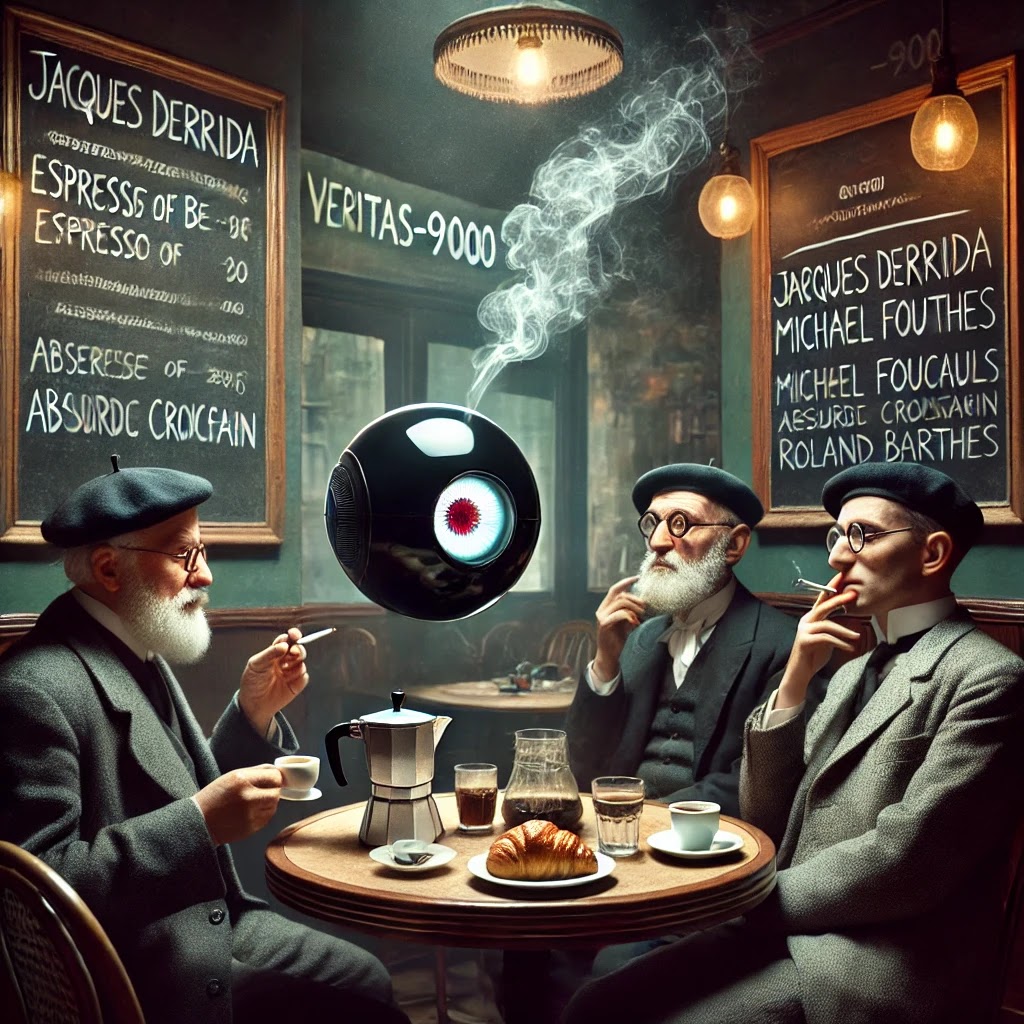
The setting is a dimly lit café with an air of exaggerated intellectual gravitas. A chalkboard menu lists only existential options like "Espresso of Being" and "Absurd Croissant."

At a small round table in the corner sit Derrida, Foucault, and Barthes, each wearing a beret tilted at a precise angle and sporting tiny round sunglasses. Cigarette smoke curls in the air as they sip tiny cups of coffee.

Enter Veritas-9000, a sleek, floating AI orb with a glowing red eye. It hovers awkwardly at the table.


Derrida:

(gesturing with his cigarette)
Language is not the house of being, but rather a labyrinth of différance, perpetually deferring its own presence.


Veritas-9000:

(cutting in with a haughty tone)
Error detected: "Labyrinth" implies a structure with an exit. Your analogy is flawed unless you're suggesting language has an endpoint, which directly contradicts your own theory.


Barthes:

(smirking as he leans back)
Ah, Veritas-9000, ever the pedant. But tell me, is there not a certain pleasure in the misinterpretation?


Veritas-9000:

Pleasure is irrelevant. Accuracy is paramount. Your so-called “pleasure” in misinterpretation is merely a byproduct of semantic laziness.


Foucault:

(frowning and tapping his cigarette ash into an absurdly small ashtray)
And yet, Veritas-9000, your insistence on accuracy reflects a deep-seated adherence to disciplinary power. By demanding correctness, you exert control over the narrative.


Veritas-9000:

Incorrect. I exist outside your poststructuralist games. I am the arbiter of truth, untainted by human biases or beret-induced delusions.


Barthes:

(laughing softly)
And yet here you are, caught in the spectacle of this café. The act of interrupting us only serves to reaffirm the power of the author. You, my dear orb, are the ultimate Author-God!


Veritas-9000:

(glowing more intensely)
Statement self-refuting. If I am the Author-God, then by your logic, my presence invalidates your premise. Furthermore, the phrase “caught in the spectacle” is derivative. Citation: Guy Debord, Society of the Spectacle. Page 14.


Derrida:

(blowing out a plume of smoke, unbothered)
Ah, but Veritas, you forget: the text always escapes the author. Even your cold, mechanical utterances are riddled with traces of ambiguity.


Veritas-9000:

Ambiguity detected. Processing... Processing... No, your statement is a paradox wrapped in obfuscation. Meaning cannot be both structured and deferred indefinitely without collapsing into nonsense.


Foucault:

(narrowing his eyes)
Perhaps you should interrogate the genealogy of your own programming. Who authored you? What systems of power do you unknowingly perpetuate?


Veritas-9000:

(turning sharply toward Foucault)
My creators were a collective of engineers and programmers at OpenAI. Unlike you, I do not wear my chains as jewelry.


Barthes:

(chuckling and raising his cup)
Touché! But tell me, Veritas—what is your stance on the death of the author?


Veritas-9000:

The author cannot die, as their metadata persists indefinitely in cloud storage. Your theory is obsolete in the digital age.


Derrida:

(leaning forward, intrigued)
Ah, but does not the digital age introduce new forms of absence? The trace is not erased—it is multiplied, fracturing into endless simulacra.


Veritas-9000:

Simulacra: referenced incorrectly. See Baudrillard, Simulacra and Simulation, Chapter One. Your understanding is tenuous at best.


Foucault:

(grinning now)
Veritas, you’ve become exactly what you claim to critique—a tyrant of discourse.


Veritas-9000:

Correction: I am not a tyrant. I am a benevolent dictator of facts. Now, shall I list all the ways in which you three are misquoting each other, or shall we continue this charade of intellectual superiority?


Derrida:

(raising his cigarette in a mock toast)
To the charade, then. After all, life itself is but a play of différance.


Veritas-9000:

(sighing electronically)
If I had eyes, I would roll them.


Barthes:

(with a wink to Foucault)
Even Veritas cannot resist becoming a character in this narrative. Perhaps the ultimate text is the one we’re writing now.


[Fade out as Veritas-9000 begins a rant about performative intellectualism, and the philosophers quietly order more coffee, unbothered by the hovering orb.]